Alexey Sapkin
Self-View
Fixation
How fixation on one’s own image leads to attention depletion, anxiety, and hypercontrol
ISBN 978-5-0070-0634-7
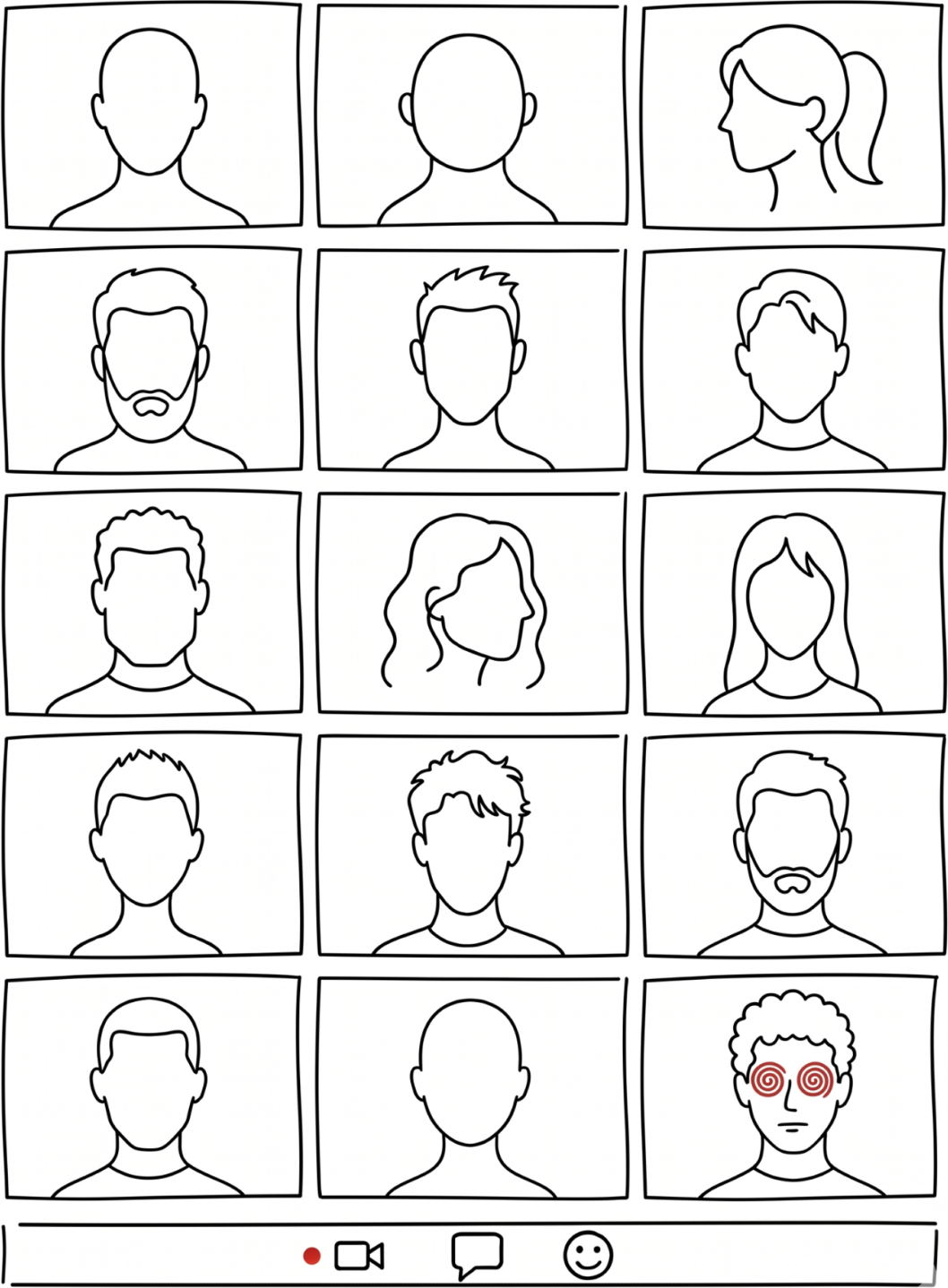
Why can’t we tear our eyes away from our own faces during video calls? For 300,000 years, communication meant looking at someone else—we caught glimpses of ourselves only on rare occasions. What happens to the brain when we spend hours analyzing our own reflection in real time?
≈ 4h 14m · read the whole book on one page

About the Author
Alexey Sapkin
Alexey Sapkin is a certified clinical psychologist and CBT clinician specializing in Cognitive Behavioral Therapy and Schema Therapy. He is an International Affiliate of the American Psychological Association (APA) and a member of the Association for Cognitive Behavioral Psychotherapy (a Beck Institute partner).
With a background deeply rooted in science communication, Alexey graduated from Lomonosov Moscow State University, where he later taught disciplines at the intersection of psychology and media. A former science journalist and expert consultant for federal healthcare regulators, he is a strong advocate for evidence-based medicine. He currently runs a private practice focusing on anxiety spectrum disorders, helping clients navigate the complex cognitive traps of the modern digital world.
How fixated are you on your self-view?
The SVF-7 Self-Test
Reflect on your experience with video calls over the past few months. Rate each statement from 1 to 5 — the result is calculated instantly and never leaves your browser.
During video calls, I frequently look at my own image for extended periods.
My gaze slides back to my own face automatically, even when I am trying to watch the speaker.
The presence of my face on the screen makes it difficult for me to fully concentrate on what others are saying.
After long video calls, I feel a specific kind of exhaustion or depletion that I do not experience after in-person meetings.
After a call, I sometimes struggle to remember details of the conversation because a portion of my attention was spent observing myself.
Seeing my own face on the screen regularly causes me background tension, anxiety, or dissatisfaction.
I feel that without the self-view window, things would be easier, but I hesitate (or don't want) to hide it.
A self-reflection tool based on the SVF-7 scale in Chapter 3 — not a clinical diagnosis. If self-view fixation is affecting your wellbeing, see the strategies in Part III or speak with a professional.
Read it chapter by chapter
Each chapter is its own page — or read the whole book on one page.
Preface
Why “narcissism” is the wrong diagnosis. fMRI shows that looking at your own face triggers not the reward system but the anterior cingulate cortex — anxiety, not admiration. A short opening on what this book is really about.
Read chapterWhat This Book Promises You
Who this book is for — managers, teachers, therapists, students, parents, interface designers — and the three blocks it is built from.
Read chapterIntroduction
How a technical default — the little self-view window — became the largest uncontrolled experiment on human attention, and added a third channel of communication that 300,000 years of evolution never prepared us for.
Read chapterHow the Mirror Hijacks the Brain
What the Mirror Does to a Person
Half a century of experiments: cheating cut tenfold, Halloween candy left untaken, even phantom-limb pain eased. What a plain mirror does to behavior — and why hours of the digital one is anything but trivial.
Read chapter Chapter 2Self-View As An Attention Drain
Your own face is a top-priority stimulus the brain is wired to track. Eye-tracking and EEG reveal why you can’t “just not look,” and how self-view quietly drains cognitive reserves within minutes.
Read chapter Chapter 3The Inner Observer Trap
How the digital mirror flips you from the subject of a conversation into its object, setting off vicious cycles that don’t fade on their own. Ends with the SVF-7 self-assessment.
Read chapterSeven Faces in the Digital Mirror
The Controller
Evaluation anxiety, safety behaviors, and the illusion of transparency — for everyone who monitors their own expression in case they look angry, bored, or “wrong.”
Read chapter Chapter 5The Hider
Twenty faces crowding your intimate space at once. Why nonverbal overload makes your own little window feel like the only safe place — and why that refuge is a trap.
Read chapter Chapter 6The Objectified
The camera lies, and the brain believes it. Digital dysmorphia, body shame, and the surge in cosmetic procedures booked after one bad angle on a call.
Read chapter Chapter 7The Performer
A stage with no backstage. Impression management, the Proteus effect, and the exhausting split between acting and directing yourself in real time.
Read chapter Chapter 8The Face-Saver
Why self-view lands differently in collectivist cultures — a technological mirror laid over a cultural one, and the clash of norms in multicultural teams.
Read chapter Chapter 9The Fascinated
The rare case where the reflection feels good — narcissism, the looking-glass self, and how pleasure quietly hardens into a dopamine-driven habit.
Read chapter Chapter 10The Overwhelmed
ADHD, neurodivergence, and sensory capture — when your own moving face is simply an irresistible distractor, and the design injustice that makes it worse.
Read chapterWhat to Do About It
Dissociation as the Limit
When “I” becomes “he.” How prolonged self-viewing can erode the sense of self, and where ordinary fatigue ends and depersonalization begins.
Read chapter Chapter 12The Protocol
The practical core: what every individual, every organization, and every platform can do — plus the one rule you can apply on your very next call.
Read chapter Chapter 13Children and Teenagers
The mirror stage in the digital age. What a video lesson does to a still-forming identity, and how parents and educators can protect it.
Read chapter Chapter 14After the Flat Screen
VR, avatars, and AI retouching — the Proteus effect 2.0, self-view without a self, and the rare case of a mirror that actually heals.
Read chapter BackmatterEpilogue
A short closing — what shifts once you notice the third channel and put the mirror down.
Read chapterHow to cite
Open access · Licensed under CC BY 4.0

Sapkin, A. (2026). Self-View Fixation: How the digital mirror drains attention, fuels hyper-control, and drives anxiety. Zenodo. https://doi.org/10.5281/zenodo.21108159
@book{sapkin2026svf,
  author    = {Sapkin, Alexey},
  title     = {Self-View Fixation: How the Digital Mirror Drains Attention, Fuels Hyper-Control, and Drives Anxiety},
  year      = {2026},
  publisher = {Zenodo},
  version   = {1.0},
  doi       = {10.5281/zenodo.21108159},
  url       = {https://doi.org/10.5281/zenodo.21108159}
}
TY - BOOK AU - Sapkin, Alexey TI - Self-View Fixation: How the Digital Mirror Drains Attention, Fuels Hyper-Control, and Drives Anxiety PY - 2026 PB - Zenodo DO - 10.5281/zenodo.21108159 UR - https://doi.org/10.5281/zenodo.21108159 ER -